
Technology in a gaming portal is a strange thing. When it works well, players barely think about it. The app opens, the game loads, the session runs without a hitch — and the player’s attention stays entirely on the game. It’s only when something goes wrong — a lag spike in the middle of a card hand, a dropped live dealer stream, a deposit that doesn’t reflect immediately — that the technology underneath the experience becomes visible.
The portals that invest properly in technology are the ones where players never have to think about it. Those that don’t invest tend to generate a specific kind of community complaint: not about the games, but about the experience surrounding them.
Hitclub is a reward gaming portal that has made consistent technology investment a part of how it competes. Where portals like GO88 have set expectations around reliable infrastructure and smooth user experience in the Vietnamese online gaming market, Hitclub has developed its own technical foundation to meet and maintain those expectations across a growing user base.
The Product Technology Is Built Around

The Hitclub game portal carries 4 game categories that each place different demands on the underlying infrastructure: card games (Tiến Lên, Phỏm, Mậu Binh, Poker) that require low-latency lobby and matchmaking systems; jackpot slots with progressive prize mechanics that need real-time prize pool updates; live dealer tables that depend on high-quality, stable video streaming; and arcade-style mini games that require fast response times for interactive gameplay. Serving all 4 categories well means the technology investment isn’t focused on a single use case — it has to perform across fundamentally different technical requirements simultaneously.
Infrastructure Investment — the Invisible Foundation
Server Stability and Uptime
For a gaming portal, downtime isn’t just a technical inconvenience — it’s a trust event. A portal that goes offline during peak hours loses sessions, and players who lose sessions without warning often don’t come back immediately. Repeated downtime creates a reputation for unreliability that takes significantly longer to reverse than the downtime itself.
Hitclub’s server infrastructure is built around uptime as a non-negotiable requirement. The portal maintains consistent availability during peak gaming hours, which in the Vietnamese market tend to cluster in the evenings and on weekends. Maintenance windows, when they occur, are communicated in advance rather than experienced as unexpected outages.
The card game section in particular depends on server stability in a way that slot games don’t — an interrupted card session leaves players mid-hand in a way that’s disruptive in a qualitatively different sense than a slot session pause. Hitclub’s lobby infrastructure handles peak traffic without the session drops that characterize portals with under-invested server capacity.
Real-Time Data Systems
Jackpot slots with progressive prize pools require real-time data systems that update prize values accurately across all active sessions simultaneously. A player watching a jackpot counter should see the same value as every other player watching it at the same moment — any lag in that synchronization undermines the integrity of the mechanic.
Hitclub’s progressive jackpot implementation handles this synchronization reliably. The prize pool updates reflect consistently across sessions, and the payout triggers operate without the anomalies that would suggest backend inconsistency. This kind of real-time data reliability is less visible than interface design but more fundamental to the experience it supports.
Mobile Technology — Optimizing for the Devices Players Actually Use
App Architecture for Mid-Range Hardware
The decision to optimize specifically for mid-range Android devices isn’t a compromise — it’s an accurate read of the Vietnamese gaming market. Players using high-end flagship phones represent a fraction of the active user base. The portal that performs well on a device purchased 2 or 3 years ago is the portal that serves the majority.
Hitclub’s app architecture reflects this prioritization. The codebase is optimized to minimize memory usage during active sessions, which reduces the likelihood of background process interference on devices with limited RAM. Loading sequences are structured to deliver the game lobby quickly rather than loading all assets before showing anything — a small architectural choice that meaningfully shortens the time between opening the app and reaching playable content.
(Technical architecture and device compatibility details: https://hitclub.cab/)
Live Streaming Technology
Live dealer tables represent the most technically demanding component of the Hitclub game portal. A real-time video stream has to maintain quality across varying connection speeds — from stable home WiFi to mobile data on a moderate signal — while the bet interface overlaid on the stream must remain responsive throughout.
Hitclub’s live streaming infrastructure uses adaptive bitrate delivery, which adjusts stream quality dynamically based on the viewer’s current connection speed. This means a player on a weaker connection sees a lower-resolution stream rather than a buffering one — a trade-off that preserves session continuity at the cost of visual quality rather than interrupting play entirely.
User Experience Investment — Designing for Daily Use
Interface Design as a Functional Choice
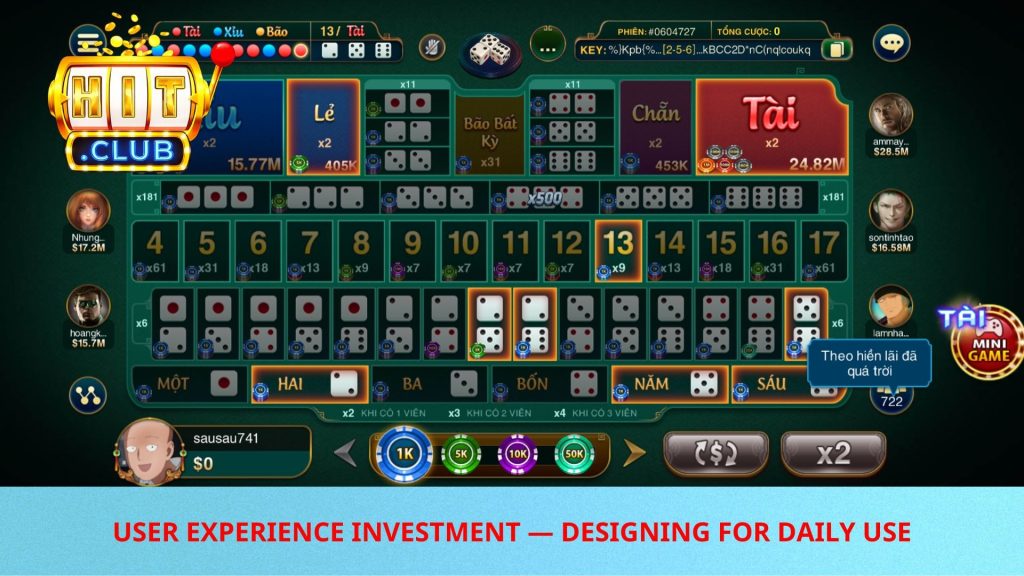
Visual design in a gaming portal isn’t primarily about aesthetics — it’s about directing player attention and minimizing friction. An interface that clutters the screen with competing elements, buries navigation options, or uses inconsistent visual language across sections creates low-level cognitive friction that accumulates across a session.
Hitclub’s interface design follows a functional logic. Game categories are clearly separated and consistently labeled. Active promotions appear in dedicated locations rather than interrupting navigation. In-game interfaces remove non-essential elements during active play, keeping player focus on the game rather than the portal frame around it.
Onboarding Design for New Players
The first 10 minutes of a new player’s experience with a gaming portal determines whether they return for a second session. Hitclub’s onboarding sequence is structured to minimize that friction — registration requires only the essential information, the initial portal tour highlights the game categories without overwhelming a new user, and the welcome promotion is presented with terms clearly visible before the player commits.
This investment in onboarding design is often invisible to players who have been using the portal for months. For new players, it determines whether Hitclub feels like a portal worth learning or one that’s too much effort to figure out.
Payment Technology — Reliability at the Most Sensitive Touchpoint
Financial transactions are the highest-stakes technical touchpoints in any gaming portal. A failed deposit during a session or a delayed withdrawal triggers immediate negative sentiment that can override otherwise positive experiences with the product.
Hitclub’s payment infrastructure supports bank transfers and major e-wallet options with deposit processing that reflects in balances within minutes. Withdrawal requests are processed through a system with no documented patterns of arbitrary holds or interface-level failures. The payment technology operates quietly — which is exactly what players need from it.
Conclusion
Hitclub’s investment in technology and user experience is most visible in what doesn’t happen: sessions that don’t drop, streams that don’t buffer, deposits that don’t delay, and interfaces that don’t confuse. These invisible outcomes are the product of deliberate infrastructure decisions, mobile optimization choices, streaming architecture, and payment system reliability. For players, the result is a reward gaming portal where the technology serves the experience rather than interrupting it — and in a competitive market where technical shortcomings drive churn, that consistency is a meaningful competitive advantage built one infrastructure decision at a time.