
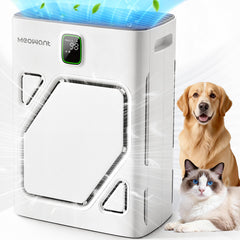
One cat is a pleasant companion. Three cats, a shedding dog, and a pair of rabbits are a full-time air quality project. Multi-pet homes generate fur, dander, litter dust, and odor on a scale that a single-pet household simply never encounters, and a purifier that seemed adequate with one animal can feel pointless with four. The numbers compound in ways that are not obvious until you live with them.
Buying for a busy household means working from real conditions: the combined shedding load, the number of litter areas, the rooms where animals actually spend time, and the outdoor environment that feeds through windows and doors. This guide treats the purchase as a small system design exercise, walking through capacity estimation, placement strategy, and the ongoing cost of keeping several stages of filtration alive at once.
Estimating the Load Your Household Actually Produces
Manufacturer coverage ratings assume a certain particle load, and most are calibrated around modest dust levels. Multiple animals push well past those assumptions. Instead of trusting the square footage on the box, estimate your own load using the variables that matter: the number of animals, their coat types, whether any of them are long-haired or double-coated, and how many litter pans are in the house.
Counting Shedding Surface, Not Just Heads
A short-haired cat and a husky in the same home do not contribute equally. Coarse, dense undercoats release far more material during seasonal blowouts, and long-haired breeds leave hair in every corner year-round. When you size a purifier, count the animals whose coats actually shed heavily and weight them accordingly. If your household includes one heavy shedder and two light ones, plan capacity as though you had at least one extra mid-level shedder on top of the headcount.
Litter Areas Multiply the Dust Problem
Each litter box is a dust generator, and each daily scooping session releases a cloud of fine clay into the surrounding air. Three boxes means three ignition points, and if they sit in different rooms, a single purifier cannot cover them all. Map the boxes on a floor plan before you shop. Sometimes the smartest move is consolidating boxes into fewer, better-ventilated locations, or planning for two purifiers instead of one oversized unit.
Capacity Planning Without Overspending
There is a real tension between buying enough capacity and buying more machine than you can maintain. A single large unit that runs at maximum speed all day may clean more air than two smaller units on moderate settings, but it will also demand more frequent filter changes and may struggle to reach around corners and into adjacent rooms. The right answer depends on the floor plan as much as the animal count.
A practical approach is to size each purifier for one primary room, then add units for the second and third rooms where pets spend time. Living room, bedroom, and the litter room are the usual candidates. This distributed layout beats a single central unit in most homes because air does not travel far between closed rooms or around furniture. It also provides redundancy: if one unit is down for filter replacement, the others keep working.
When One Unit Still Makes Sense
Open-plan apartments sometimes do better with a single strong unit placed centrally, especially if doors stay open and the layout is genuinely open. In that case, prioritize a model with high airflow at tolerable noise and a large carbon stage, and accept that the far corners will lag behind. Check the noise rating at low speed specifically — in a compact home, the purifier will be audible in every room.
Placement Strategy for a Busy Household
Placement matters more in multi-pet homes because the pollution sources are spread out. The purifier's job is to intercept pollutants before they migrate through the house, which argues for source-adjacent placement in most cases. A unit near the litter area catches ammonia and dust early; a unit in the main living space handles dander and hair tracked in by animals and people alike.
Source Control Beats Room Coverage
Air purifiers are often marketed as room cleaners, but in pet homes they are more effective as source interceptors. Position the intake where the pollutant concentration is highest — the litter room, the pet bed corner, the doorway pets use most — and let the unit work on the densest air first. This is especially true for odor, which rises and drifts along ceiling and airflow paths. A strategically placed unit near the source can outperform a larger unit in the middle of the room.
Keep Intakes Clear in a Crowded Home
Multi-pet homes are cluttered by nature: toy bins, cat trees, and beds all compete for floor space. While arranging the room, preserve a clear buffer around every purifier intake. Curtains and piles of blankets are common culprits that quietly reduce airflow. If an animal likes to sleep against the unit, check that the intake is on a side that remains open, or choose a model with a top-mounted intake that is harder to block.
The Ongoing Cost of Filtration at Scale
Filter replacement is where multi-pet budgets tend to break. A stage that lasts a year in a clean home may last a few months when loaded with fur and dander from multiple animals. Before purchasing, price the full replacement set and multiply by the realistic number of changes per year. A cheaper unit with proprietary cartridges can end up costing more than a premium model with widely available filters.
Maintenance time is the other hidden cost. Several purifiers across several rooms mean several pre-filters to vacuum and several cartridges to swap. Batch the work into a single weekly routine — a quick pass over each pre-filter on a fixed day — so it becomes a five-minute habit rather than a chore that gets postponed. Track replacement dates on a shared calendar, since the filter indicators on different brands rarely agree on their thresholds.
Features That Earn Their Place in a Full House
With several animals, a few design details move from nice-to-have to genuinely useful. Washable pre-filters cut consumable costs dramatically. A high carbon mass handles the ammonia that multiplies with every litter box. Quiet low-speed operation keeps the unit running overnight even in a bedroom shared with pets. And accessible filter doors matter, because a design that requires disassembly will be serviced less often.
Noise also matters more with animals in the house, because a loud unit can unsettle nervous pets and a purifier that spooks a cat will end up in a closet. Run the unit on its highest setting when the room is empty, and keep the overnight speed low enough that animals nap beside it without stirring. Stable footing is worth checking too: a unit on a wobbling shelf will buzz, and a dog brushing past it can knock it over.
Smart features can help, but only when they reduce friction. Air quality indicators that change color are useful for spotting when a stage is saturated; app scheduling helps coordinate multiple units. None of it compensates for a filter stack that is too small for a busy household, so treat connectivity as a tiebreaker rather than a driving reason to buy.
If you are building a multi-unit setup, the pet air purifier range from Meowant offers models suited to different room sizes, making it easier to cover several spaces without overspending on any single unit. Match each purifier to the room it will serve, and the household's air quality becomes a matter of maintenance rather than guesswork.
Seasonal Shifts in a Multi-Pet Home
Shedding is not a flat year-round event. Spring and fall coat blowouts can double the particle load in a matter of weeks, and heating season lowers indoor humidity, which keeps fine dust airborne longer. A household that runs two purifiers comfortably in June may feel under-served in November. Build flexibility into the plan: keep a spare replacement filter on hand, and adjust fan speed and cleaning frequency when the seasons change rather than discovering the gap after the air has already turned stale.
Sizing the Solution to the Whole Household
A house full of animals needs more than a purifier; it needs a plan. Estimate the real shedding and dust load, decide whether one strong unit or several distributed ones fit your floor plan, and place them where pollutants originate. Then budget honestly for filters, because capacity without maintenance is just an appliance spinning its wheels.
Do this well and the result is quietly impressive: less visible fur, fainter litter odor, and a home that feels fresh even when several pets share the space. The work is mostly in the setup and the routine — the purifiers themselves simply keep doing their job in the background.