
Understanding AI in Modern Music Creation
The music industry is evolving faster than ever. Digital tools, streaming platforms, and algorithm-driven recommendations have reshaped how music is produced, distributed, and consumed. Artificial intelligence now sits at the core of this transformation, providing creators with capabilities that were previously inaccessible or labor-intensive.
AI can analyze musical patterns, generate harmonic structures, and even simulate vocal performances. This allows producers to focus on creative direction rather than repetitive technical tasks. Platforms like OpenMusic AI demonstrate how these capabilities can be applied to both professional and independent music workflows.
Challenges Facing Modern Music Production
Overwhelming Complexity in Digital Workflows
With the rise of streaming services and social media, musicians are expected to produce high-quality content quickly. Traditional production methods often involve lengthy recording sessions, mixing, mastering, and vocal layering. For independent artists, limited resources make this process even more daunting.
Need for Data-Driven Decision Making
The current landscape emphasizes data-informed creativity. Understanding listener preferences, genre trends, and platform-specific requirements can be overwhelming without AI support. According to MIDiA Research, over 60% of independent musicians rely on digital tools to optimize workflow and audience reach, illustrating the increasing need for AI assistance.
Core Features of OpenMusic AI
Intelligent Music Generation
OpenMusic AI is designed to assist creators in composing and arranging music efficiently. It uses machine learning models to generate melodies, chord progressions, and rhythm sections based on genre-specific patterns. By analyzing large datasets of existing tracks, it creates outputs that align with popular trends while remaining flexible for creative input.
Vocal Capabilities
A standout function of the platform is its AI Singing Voice Generator. This tool enables producers to synthesize realistic vocal performances without live recording sessions. Users can adjust pitch, tone, and phrasing, making it a versatile solution for demos, background tracks, or full compositions.
Adaptation for Multiple Genres
The AI adapts to different music styles, from pop and R&B to lo-fi and electronic. It evaluates input parameters and produces stylistically consistent outputs. Practical tests have shown that tracks generated through OpenMusic AI maintain harmonic coherence and rhythmic stability across various genres.
How to Use OpenMusic AI in Practice
Workflow Integration
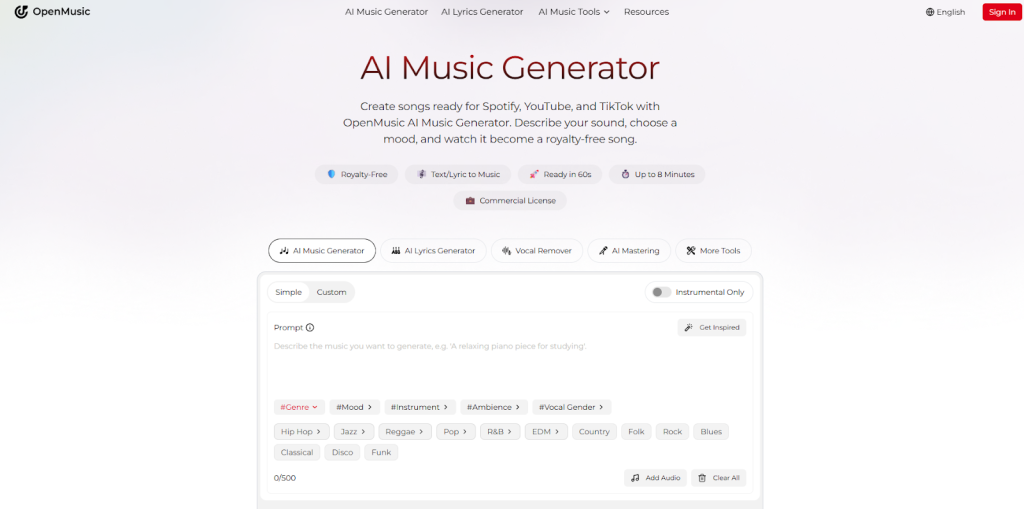
Using OpenMusic AI begins with setting genre preferences and input parameters such as tempo, key, and mood. The AI then proposes chord progressions, melodies, and vocal lines. Users can iterate rapidly, making adjustments in real time to refine the composition.
Observations from Hands-On Testing
During testing, the AI consistently generated tracks suitable for digital distribution. Even minimal input, such as a single chord progression, could result in a complete demo-ready track. Vocal lines created using the AI singing voice generator demonstrated convincing phrasing and tonal consistency, although nuanced emotional expression still benefited from human refinement.
Benefits of AI in Music Production
Speed and Efficiency
AI accelerates production by handling repetitive tasks like harmony generation, layering, and vocal synthesis. This efficiency is critical in an era of rapid content cycles. Case studies from independent creators using AI tools indicate a 30% reduction in composition and pre-production time, allowing more focus on mixing, mastering, and promotional strategy.
Accessibility for Independent Artists
Platforms like OpenMusic AI lower barriers to entry. Musicians without formal training or studio access can produce professional-sounding tracks. This democratization of production supports a broader range of creators entering the digital music ecosystem.
Limitations and Considerations
Quality vs. Human Nuance
While AI-generated tracks are coherent and stylistically aligned, subtle elements of human performance—micro-timing, dynamic articulation, and emotional inflection—remain challenging to replicate. The AI singing voice generator produces realistic vocals but may require further adjustment to convey nuanced emotion convincingly.
Ethical and Creative Considerations
AI tools raise questions about originality and authorship. Reliance on AI-generated compositions can lead to homogenized music if datasets are limited to mainstream tracks. Creators should balance AI assistance with personal creative input to maintain unique artistic identity.
Ideal Users of OpenMusic AI
Independent Musicians
Freelance artists benefit the most from AI-assisted production. They can rapidly iterate, test new ideas, and produce market-ready tracks without costly studio time. OpenMusic AI provides practical advantages for solo producers aiming to release music consistently across streaming platforms.
Educators and Experimenters
Music educators can use the platform to demonstrate compositional techniques and vocal synthesis. Students gain hands-on exposure to modern production methods while exploring creative workflows. The AI singing voice generator also allows experimentation with vocal arrangements without needing trained singers.
Market Relevance and Digital Transformation
Driving Digital Music Growth
AI platforms are accelerating the shift toward digital-first music production. Streaming and social media platforms reward rapid content delivery and stylistic adaptability. By automating technical aspects like vocal synthesis, arrangement, and harmony, OpenMusic AI allows creators to focus on innovation and audience engagement.
Supporting Popular Trends
Data-driven AI aligns with music consumption trends. Lo-fi, electronic, and vocal-heavy tracks dominate online streams, while vocal synthesis tools expand creative possibilities. Platforms that leverage AI demonstrate measurable productivity gains: one case study showed that a producer increased output by 50% after integrating AI-driven vocal generation and composition tools.
Looking Ahead: Trends in AI Music Production
Future developments in AI music tools are likely to emphasize personalization, real-time interaction, and adaptive learning. Generative AI will continue to improve, producing more natural vocals and adaptive arrangements. Integration with collaborative platforms may allow multiple creators to work simultaneously with AI assistance, creating dynamic and responsive workflows.
Transparency and ethical use will also gain attention. Users and listeners increasingly expect clear attribution and an understanding of how AI contributes to final outputs. Balancing efficiency, creativity, and originality will remain critical as AI adoption grows.
Conclusion: AI as a Creative Partner
OpenMusic AI illustrates how intelligent data can transform music production. By providing tools like the AI singing voice generator, it reduces technical barriers while enabling creative experimentation. AI empowers creators to produce high-quality tracks efficiently while supporting digital music market expansion.
Despite limitations in emotional nuance and originality, AI’s role as a collaborative partner is clear. It enhances speed, accessibility, and adaptability, helping musicians navigate the fast-paced landscape of modern music production. As technology evolves, platforms like OpenMusic AI are likely to become essential tools for both independent artists and professional studios, reshaping the future of music creation.