
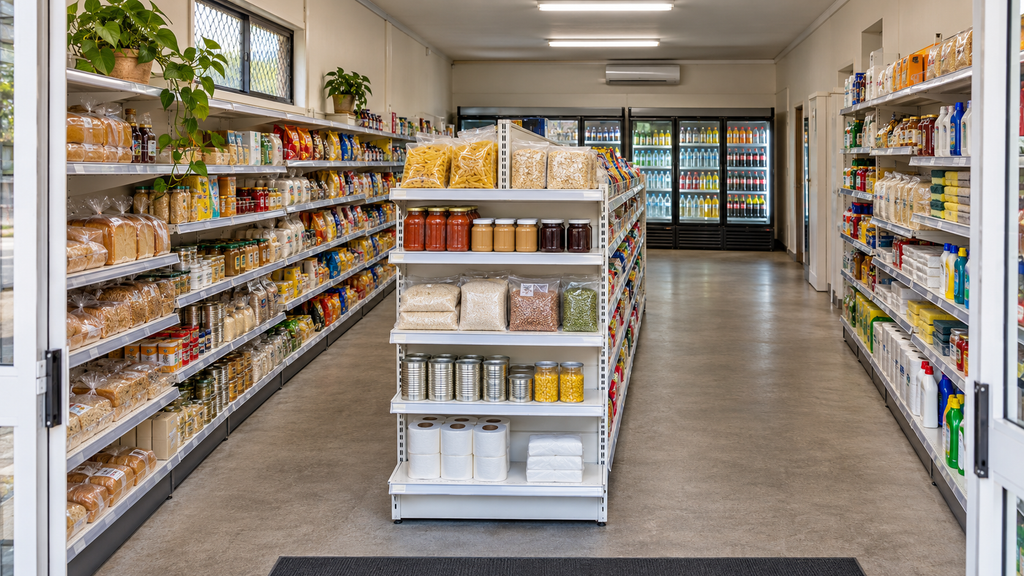
A grocery aisle reset should give the revised range a workable home without making regular customers hunt for familiar products. Before moving anything, decide which lines are leaving, how much space the new lines need and what must remain available during the changeover.
The aim is a shelf plan that fits the products, supports replenishment and keeps prices accurate. Filling every gap on reset night is not enough if the same aisle runs short of key items the next afternoon.
Confirm the range before changing the shelves
Create one agreed list of retained, discontinued and incoming products. Record each item’s barcode, pack dimensions, case quantity, stock on hand and expected delivery date. Separate confirmed new lines from products that are still awaiting approval or supply.
Gondola shelves can allow shelf positions and accessories to change within an existing run. Before planning around that flexibility, check that the components are compatible and that the proposed arrangement stays within the manufacturer’s loading and installation instructions.
Give discontinued stock an explicit destination: its existing position until sold, a clearly priced clearance location, an agreed supplier return or another approved stock process. Otherwise it is likely to reclaim the space reserved for the new range.
Use sales and product dimensions together
Review comparable weeks of unit sales, noting promotions and periods when stock was unavailable. A low sales total caused by an empty shelf is not evidence that the product needs less space. Consider the category’s role as well: a modest seller may complete an important customer shopping mission.
According to Neil Webster, CEO at Mills Shelving, retail fixtures should support merchandising, efficient replenishment and changes as the business develops. His published advice describes shelving as something that should “support the way a store operates, not limit it”. For a range reset, that principle means checking whether the revised arrangement can be maintained in daily trading, alongside whether the products physically fit.
Draw the new shelf plan before moving stock
A planogram is a map of which products go where. A small store can begin with a measured sketch or spreadsheet: identify the bay, shelf, product, number of facings and shelf capacity. A facing is one product front visible to the customer; it is not the number of units stored behind it.
GS1 Australia’s Trusted Content service includes product dimensions and barcode details supplied by brand owners. Accurate product data can help build the plan, but physically check samples where packs, trays or shelf-ready cartons affect the fit.
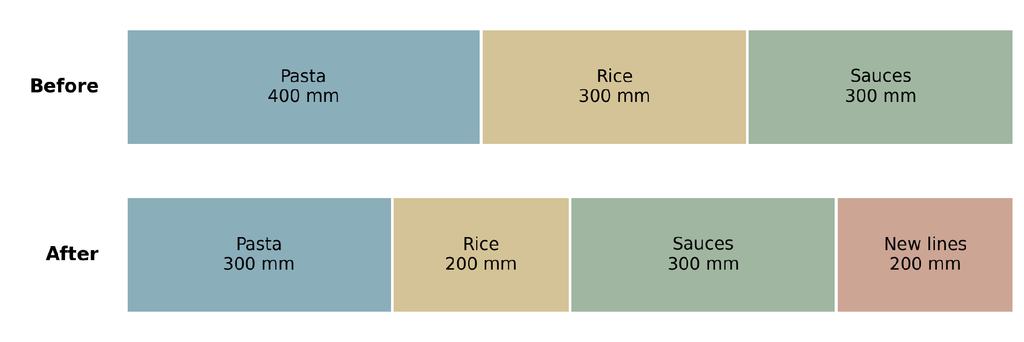
Figure 1. Hypothetical allocation of 1,000 mm of usable shelf frontage. The reset releases 200 mm for new lines. These are category widths, not product facings or measured sales results.
In this example, pasta gives up 100 mm and rice gives up 100 mm while sauces retain their space. Only make those reductions if the retained products still have adequate capacity. Reserve space for the actual packs and dividers; a nominal bay width may exceed the usable shelf frontage.
Check how long the shelf will stay stocked
Suppose one product sells an assumed six units a day and staff normally replenish it every two days. It needs room for at least 12 units to cover that interval before allowing for demand variation. If each facing holds four units, three facings provide 12 units; two provide only eight.
Those figures are an illustration, not a recommended stock target. Use your own sales pattern, replenishment schedule and pack dimensions, then allow a sensible buffer. Check height, depth, weight and access as well as frontage. A product that fits tightly may still be awkward to pick or replenish.
Carry out the reset in controlled sections
Schedule the work for a quiet period and assign responsibility for stock, fixture changes, labels and final checks. If the store remains open, isolate the working section and maintain a clear shopping route. Avoid dismantling the entire aisle when one bay can be completed and checked at a time.
Photograph the existing arrangement, count affected stock and unload the section before adjusting shelves. Clean and inspect the components, make the approved changes and position retained stock according to the new plan. Rotate suitable older stock forward and check date-sensitive products before returning them to sale.
Mills Shelving’s published guidance describes using compatible modular components to change a display without always replacing the complete system. Apply that principle carefully: an aisle reset is an opportunity to reuse sound fixtures, while replacing damaged or unsuitable parts before the shelves are loaded again.
Match every label to the product above it
Remove obsolete labels as products move. Check the item description, pack size, barcode and selling price against the store’s system. Update unit pricing where applicable and remove promotional tickets that no longer match the range or offer.
Before reopening the section, have a second person compare the shelf against the plan and scan a sample from every changed product line. Update aisle signs and tell staff where moved items now belong. A dated photo of the finished bay gives the next shift a useful reference.
Review the result after normal trading resumes
Check shelf gaps and replenishment workload after the first full trading day, then review again after a normal replenishment cycle. Compare sales over similar trading periods and record promotions, availability problems and other changes that could explain the result.
If a retained line repeatedly empties, revisit its capacity or replenishment frequency. If customers cannot find a moved category, improve the signs or location. Keep the revised plan dated and current so small corrections become part of the agreed layout, rather than undocumented changes between shifts.
Editorial sources and placement notes
Expert insight and experience statement: Mills Shelving retail guidance and modular shelving information. Industry reference: GS1 Australia Trusted Content. Figures and calculations are original hypothetical examples.
Publisher: fxsound.org. No relevant internal article was verified through site-restricted searches. Robots and sitemap checks returned access errors, so no internal link is included. Research checked 12 November 2026. Remove these editorial notes before publication. Retain the target hyperlink as an ordinary followed link in the CMS.