
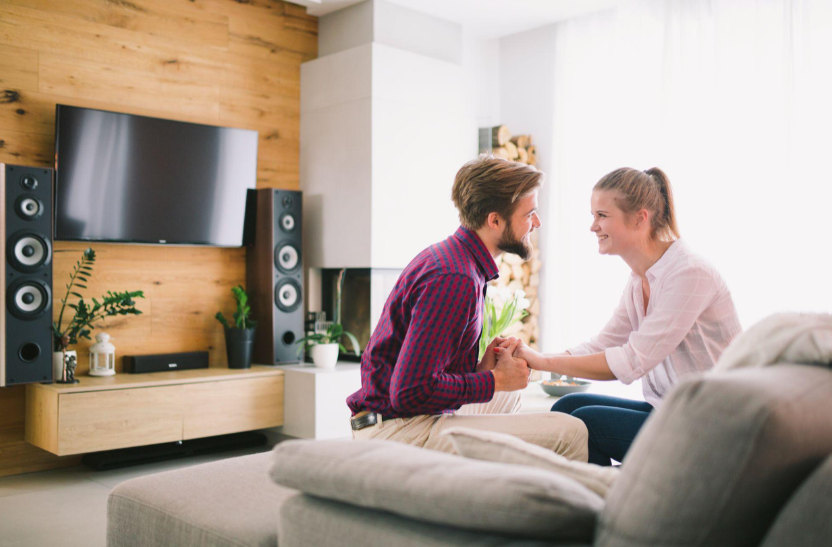
Despite choosing some great speakers and taking the time to set them up properly you may be noticing any muddiness and the vocals seem to come out of nowhere.
It’s actually quite common to get this issue in smaller living rooms. The tight space, couch wedged up against one wall, and coffee table in the middle will all affect how sound travels.
The good news is that you don’t need to have a dedicated listening area or acoustic panels all over the walls. Speaker positioning can have a much bigger effect than most people think, and making small changes can make a big difference.
This guide will help with a solid base layout to start with, how to reduce booming bass, how to avoid issues with your furniture, and an easy way to test your changes.
The Best Starting Layout for a Small Living Room
Here’s the short answer for most rooms. Place your speakers about 1 to 2 feet out from the wall behind them and roughly 4 to 6 feet apart. Then position your seat so your head and the two speakers form an equal-sided triangle. If the room is longer than it is wide, the short wall usually works best, because the sound gets more distance to travel before it reaches the back wall.
What if your sofa is pushed against the back wall? That’s very common, and it isn’t a dealbreaker. Pull the speakers slightly closer together, angle them toward you, and keep the triangle a bit smaller so your ears stay in the sweet spot. Even moving the sofa 6 inches away from the wall can reduce some of the bass boom, and that small gap also keeps reflections from piling up right behind your head.
Furniture in the middle of that triangle matters as well, since a hard tabletop sits directly in the path of sound heading toward your seat. In a tight layout, round coffee tables make a lot of sense because they leave clear walking paths to the speakers and have no sharp corners to catch your shins.
A home furnishings retailer that sorts its coffee tables by shape and size makes it easier to compare footprints before you move anything. For the tabletop itself, wooden coffee tables are a sensible choice, since wood reflects less harsh, bright sound than glass does.
If the textbook setup won’t fit your room, this table compares realistic alternatives:
| Setup | Typical Distance From Back Wall | Best For | Main Trade-Off |
| Speakers on the short wall | 1 to 2 ft | Long, narrow rooms | Sofa may end up near the rear wall |
| Speakers on the long wall | 1 to 2 ft | Wide, shallow rooms | Seat often sits close to the back wall |
| Near the rear wall | 4 to 8 in | Very tight rooms, front-ported speakers | More bass, less depth |
| On stands away from the wall | 2 to 3 ft | Clearest sound and stereo image | Takes up floor space |
| On shelves or a media console | 0 to 6 in | Shared rooms with little space | Boomy bass and surface reflections |
Taming Boomy Bass When Walls Are Close
Why Walls and Corners Boost Bass
Every wall near a speaker reflects low notes back into the room, and those reflections pile onto the original sound. A corner adds three surfaces at once, which is why corner bass often sounds thick and one-note. Small rooms feel this more strongly because there’s less space for the energy to spread out.
Quick Fixes for Ported Speakers
Check the back of each speaker first. An opening there is a rear port, which needs breathing room, while front-ported models usually cope better near walls. If boom is still a problem, try these fixes one at a time:
- Move the speakers out from the wall a few inches at a time.
- Keep them out of the corners, even if you only gain a foot.
- Insert the foam port plugs that often come packed in the box.
- Add a thick rug and heavy curtains to absorb extra low-end energy.
Fitting Speakers Around Your Living Room Furniture
Coffee Tables, Sofas and Sightlines
A table placed directly in front of a speaker can bounce treble off its surface and blur the detail in voices. Keep a clear line between each speaker and your ears, which is where low, open designs help, since many modern coffee tables have slim legs and open shelving that let sound pass through.
For the same reason, position living room centre tables between the sofa and the speaker line rather than in front of the speakers. You keep your legroom, your view of the TV, and a cleaner stereo image.
Shelves, Side Tables and Stands
Dedicated stands usually beat furniture because they lift speakers to ear height and keep them off hollow surfaces that buzz. If stands won’t fit, a sturdy shelf or side table works, ideally with rubber pads underneath and the speaker pulled to the front edge so the shelf doesn’t add its own boom.
Fine-Tuning Toe-In, Height and Your Listening Spot
Height comes first. The tweeters, those small drivers at the top of each speaker, should sit close to your ear level when you’re seated, usually about 36 to 40 inches off the floor, and tilting them back slightly helps if they rest low on a console.
Toe-in comes next. Pointing both speakers straight at your head gives a sharp, focused center image, while keeping them nearly parallel spreads the sound wider for rooms where people sit in different spots.
You can also move the seat instead of the speakers by shifting the sofa a few inches forward or back, keeping both sides of the triangle even. Keep the volume moderate while you experiment, because long or repeated exposure to sounds at or above 85 decibels can cause permanent hearing loss.
How to Test and Adjust by Ear
Tiny moves often make the biggest difference in a small room, so set aside about 20 minutes for these steps:
- Mark each speaker’s position on the floor with painter’s tape.
- Choose one song you know well, ideally with deep bass and a clear vocal.
- Sit in your usual spot and listen for boomy notes, thin vocals, or a fuzzy center.
- Move one speaker an inch or two, then match the change on the other side.
- Tape the best position so you can always find it again.
A free room measurement app paired with an inexpensive USB microphone can show where bass peaks sit, but your ears still get the final vote.
Summary
Begin by placing the speakers 1- 2 ft from the wall (with 4- 6 ft between each speaker), pointing towards a chair in a loose triangular setup. After this, you can work on the peculiarities of your room by moving things around slightly, using speaker port plugs and soft furnishings.
Ultimately, you should rely on your ears when setting them up. You will never get perfect studio quality from a small living room, but by using tape markers, playing one song you are familiar with, and being patient, you can get crystal-clear vocals and tight bass.
Make one change at a time and really listen to what you are getting. Choose the setup you like the most.
FAQ’s
What is the 38% rule?
This is an approximate guideline for where to place your chair. Sit approximately 38% from the front/back wall of your room. This means your ears won’t be in the problem areas with too much bass. For a small room, this is a good place to start, but do rely on your ears.
How can I improve acoustics in my room without renovating?
The main thing to do is add soft furnishings. A thick rug, heavy curtains, and furniture with upholstery will help reduce harsh reflections and echo. Bookshelves with irregular items will also help diffuse the sound. Try adding soft materials to the side walls to reduce the first reflection. Don’t have large bare surfaces facing your speakers.
How far should I place my speakers from the wall?
Try to get at least 6-12 inches between your speakers and the wall. If possible, try to get more distance. Having them closer will increase the bass but may cause the sound to become muddier. If your speakers have rear ports, then you will want to give extra space. Moving them just a few inches can make a big difference in how tight they sound.