
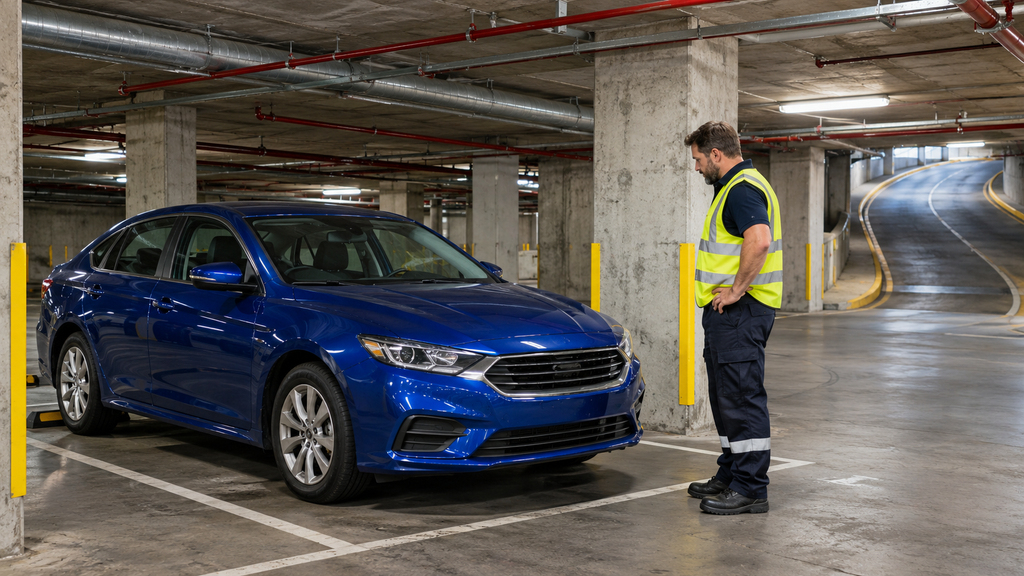
When a car will not move inside an underground car park, the first challenge is reaching it. A truck that can carry the vehicle on the road may not fit through the entrance, negotiate the ramp or turn beside its parking bay. Booking the right recovery starts with describing the entire route out.
When arranging Canberra Towing, explain at the beginning of the call that the vehicle is underground. Give the building address, entrance street, parking level and bay number. Then describe the access restrictions so the operator can assess whether their equipment suits the site.
Check the route rather than just the entrance
Read the posted clearance from a safe position or ask building management for it. Do not estimate a measurement you cannot confirm. Mention overhead pipes, a second height barrier, tight corners, steep ramps and any change in ceiling height between levels.
The entrance sign alone does not establish whether a recovery vehicle can complete the job. The operator must consider its working height, turning room and the way the disabled car will be moved. A vehicle that fits through the gate may still have difficulty at the bottom of a ramp or beside a closely spaced pillar.
Photographs can help explain the entrance, ramp and space around the car. Take them from pedestrian areas where possible, without walking into vehicle movements. Include a wider view of the parking bay, not only a close-up of the fault.
Explain whether the car can roll and steer
Provide the make, model and registration, then describe what happened. Tell the operator whether the keys are available, the battery is flat, the steering is locked or a wheel is damaged. Mention an electronic parking brake or a transmission that will not leave park.
Do not force a gear selector, release a parking brake on a slope or try to push the vehicle up a ramp. Tell the operator what you know and leave unfamiliar release procedures to someone who can follow the manufacturer’s instructions safely. Electric vehicles and all-wheel-drive models can have specific transport requirements.
The recovery planning perspective
An underground recovery should be planned from the parking bay all the way to the loading area. Clearance is only one constraint; ramp angles, turning space and the vehicle’s ability to roll can change the recovery method. Sharing photographs and access details before dispatch helps the operator assess those constraints together and identify where building management’s assistance may be needed.
Arrange access with building management
Contact the concierge, security team or facilities manager. Confirm who can open gates, provide access to restricted levels and remain available during the recovery. Ask whether there are delivery windows or another entrance the operator should assess.
Management may also need to organise nearby vehicle movements or keep pedestrians away from the working area. Do not remove barriers or interfere with fire equipment yourself. If there is smoke, fire or another immediate threat, follow the building’s emergency procedure and contact emergency services.
Agree on the recovery and onward transport
A restricted-access job may involve moving the car to an accessible loading point before onward transport. Ask whether the quote covers both stages and whether additional equipment, waiting time or storage could affect the price. Avoid assuming that an ordinary roadside towing price includes a basement recovery.
Underground Towing & Salvage advertises specialist low-clearance recovery in Canberra. The useful question for any provider is whether its equipment suits this particular building and vehicle. Access needs to be assessed for the actual job; a low-clearance description is not a guarantee that every basement is reachable.
Confirm the repairer’s address and opening hours, who will hand over the keys and where passengers will wait. Tesla’s Model Y transporter guidance, for example, requires all four wheels off the ground during transport. The operator should follow the instructions for the actual vehicle involved. Keep the access contact reachable until the car is outside and the onward arrangements are settled.
Describe the parking bay and nearby obstacles
Tell the operator whether the car faces a wall, backs onto a pillar or sits between other vehicles. Explain whether there is room in front, behind and along the sides. A wide entrance does not help if the recovery equipment cannot be positioned beside the disabled vehicle. Mention wheel stops, raised kerbs and any damage that has changed the position of a wheel.
If an adjacent space is occupied, ask management whether its owner can be contacted. Do not assume another vehicle can be moved immediately, and do not promise the operator an empty working area unless it has been arranged. Where information is uncertain, identify the uncertainty clearly. Saying that the neighbouring bay may be occupied is more useful than describing the area as clear.
Make one person responsible for access
Choose a contact who can answer the driver’s call and arrange entry. This may be you, the concierge or a facilities manager. Give the operator that person’s name and number with their agreement. Explain if a swipe card works only for residents, if the gate closes automatically, or if visitors must sign in before entering the parking area.
Check whether the same access arrangements apply when leaving. An exit may require a ticket, a sensor or assistance from security. If the recovery crosses multiple levels, management may need to coordinate several doors or gates. Resolving these details beforehand reduces avoidable waiting, particularly outside normal reception hours. Keep any access cards with the person managing entry rather than leaving them inside the disabled car.
Understand why recovery may happen in stages
The equipment that reaches a basement vehicle may be different from the truck that transports it to the repairer. Depending on the site and vehicle, the operator may first move the car to a suitable outdoor loading area. That area must be assessed for space, vehicle movements and permission to use it. The nearest driveway is not automatically an appropriate loading point.
Ask who will coordinate the transition between recovery and transport. Confirm whether the same provider handles both stages and whether the vehicle will be attended while waiting. You do not need to choose the technical method yourself. Your role is to provide accurate access and vehicle information, then understand the proposed sequence and the costs attached to it.
Prepare for collection without moving the car yourself
Keep the keys available and gather the repairer’s contact details. Remove personal belongings only when the vehicle is safe to approach. If the car belongs to an employer, rental company or family member, establish who is authorised to arrange its removal. Tell the operator if that person will not be present and ask what information is needed for the handover.
Once the driver arrives, give them room to assess the site. Keep passengers and bystanders away from recovery equipment and follow the agreed pedestrian route. Do not stand behind the car on a ramp or attempt to help push unless the operator has specifically directed a safe procedure. Before leaving, confirm the delivery destination, key handover and how you will receive confirmation that the vehicle has arrived.
Underground Towing & Salvage, founded by Joshua Harrison, provides breakdown recovery and vehicle transport services. Its published account of Joshua’s work includes accident recovery, underground car park towing and complex vehicle extractions. For motorists, the practical lesson is to describe both the vehicle and its surroundings: the destination, access and loading conditions all matter when arranging a recovery.