
Distance is no longer the barrier it once was when it comes to Philippine civil registry documents. Whether you are working in the Middle East, studying in Europe, settling in North America, or based anywhere else in the world, obtaining an official birth certificate PSA copy from outside the Philippines is genuinely achievable in 2026 and in most cases, it does not require you to fly home or rely on a relative to stand in a long queue on your behalf. This guide covers every available method for Overseas Filipinos to request their civil registry birth certificate while abroad, along with the practical steps, timelines, and special considerations for each option.
Why Overseas Filipinos Need Their PSA Birth Certificate
Living abroad does not reduce the need for Philippine civil registry documents in many cases, it increases it. Common reasons Overseas Filipinos request their birth certificate from abroad include:
- Visa and immigration applications foreign embassies and immigration authorities frequently require a Philippine birth certificate as proof of identity and citizenship
- Dual citizenship applications Filipinos who have naturalized abroad and wish to reacquire their Philippine citizenship need a birth certificate as foundational documentary proof
- Overseas employment documentation pre-departure and employment contract processing through the relevant government authorities often requires civil registry documents
- Marriage abroad registering a marriage in a foreign country typically requires documentary proof of the Filipino party’s identity and civil status
- Estate and inheritance matters property and estate proceedings involving Philippine assets often require the death certificate of the deceased and birth certificates of heirs
- Philippine passport renewal first-time passport applicants always require a birth certificate, and certain renewal scenarios also require it
- Children’s documentation Filipino parents abroad registering a child’s birth through a Philippine Embassy or enrolling a child in a Philippine school typically need the parents’ birth certificates.
Method 1: Online Request Through the Official Civil Registry Ordering Channel
This is the most practical and widely used method for Overseas Filipinos who need a birth certificate delivered to a Philippine address from which a trusted contact can forward it internationally.
How It Works
The official online ordering system allows anyone with internet access to submit a birth certificate request, pay digitally, and have the document delivered by courier to a Philippine address. The entire process happens remotely: no office visit, no appointment, no Philippine presence required from the requester.
Step-by-Step Process
Step 1: Prepare the document owner’s personal information
Before opening the ordering form, confirm these details:
- Full legal name first, middle, and last name exactly as registered
- Date of birth day, month, and year
- Place of birth city or municipality and province
- Mother’s full maiden name her surname before any marriage
- Father’s full name as registered
Cross-reference these details against an existing copy of the birth certificate, a Philippine passport, or school records. Do not rely on memory, particularly for parental names and place of birth details.
Step 2: Choose a Philippine delivery address
Since the physical document will be delivered within the Philippines, choose a trusted family member’s or friend’s address as the delivery destination. This person will receive the package on your behalf and then forward it to you internationally using a courier of their choice.
Provide a complete delivery address, street number, street name, barangay, city or municipality, province, and postal code. Include a building name and unit number if the address is a condominium or apartment. An incomplete address is one of the most common causes of failed delivery attempts.
Step 3: Complete the order and pay
Most official ordering systems accept internationally issued credit and debit cards from major networks. If you also maintain a Philippine digital wallet account or a Philippine bank card, those may also be accepted depending on the platform.
After payment is confirmed, a reference number is sent to your registered email and mobile number. Save this reference number it is your primary tool for tracking the order’s progress.
Step 4: Your Philippine contact receives and forwards the document
Once the document arrives at the Philippine delivery address, your contact in the Philippines forwards it to you internationally. For documents that will be used for legal or immigration purposes abroad, coordinate with your contact to send the document through a reliable international courier service that provides tracking and delivery confirmation.
Timeline: The online request typically takes two to three business days for the civil registry to process the document, plus regional delivery time within the Philippines. International forwarding adds additional time depending on the carrier and destination.
Method 2: Authorize a Family Member or Representative to Request In Person
If you prefer the document to be obtained through a walk-in appointment at a civil registration outlet, you can authorize a trusted family member or representative in the Philippines to do this on your behalf.
What You Need to Prepare
Authorization letter: Prepare a signed letter authorizing the specific person who will request the document. The letter must include:
- Your full legal name
- The representative’s full legal name
- Your relationship to the representative
- The specific document being requested
- Your handwritten signature
The letter does not need to be notarized for most standard civil registry requests, but having it notarized at your nearest Philippine Embassy or Consulate adds legitimacy and reduces the risk of the request being questioned.
Copy of your valid identification: Your representative must bring a photocopy of your valid Philippine identification document typically your Philippine passport. Send a clear scan or photocopy of your passport’s biographical data page to your representative so they can print and bring it.
Your representative’s own identification: The person making the request in person must also bring their own original valid government-issued identification document.
The In-Person Process
Your representative books a civil registration outlet appointment through the official booking system using their own contact details, attends the appointment, presents all required documents at the counter, and receives the birth certificate on the same day if the record is found. They then send the document to you through the international courier of your choice.
Method 3: Request Through a Philippine Embassy or Consulate
Philippine Embassies and Consulates provide civil registry document request services for Filipino nationals abroad. This pathway eliminates the need for a Philippine contact entirely the Embassy or Consulate handles the coordination with the civil registry authority on your behalf.
How to Use This Method
- Contact the Philippine Embassy or Consulate nearest to your location and inquire about their civil registry document request service not all posts offer this service at the same level of convenience, and procedures vary by location
- Ask for the specific requirements, forms, and current fees for requesting a birth certificate through the post
- Submit the required documents and fees as directed this is typically done in person during consular hours or by mail depending on the post’s procedures
- The Embassy or Consulate forwards your request to the relevant civil registry authority in the Philippines
- Once processed, the document is released through the post or mailed to you
Timeline: This method is the most variable in terms of processing time. Depending on the post’s current workload and coordination timelines with the Philippine civil registry authority, processing can take anywhere from several weeks to a few months. It is best suited for situations where there is no urgent deadline.
Method 4: Request Through the Philippine Consulate’s POLO Office (For OFWs)
For Overseas Filipino Workers specifically, the Philippine Overseas Labor Office (POLO) attached to Philippine Embassies and Consulates often provides document facilitation services in coordination with the relevant government agencies. POLO-assisted document requests are particularly useful for OFWs who need civil registry documents as part of their employment or pre-departure documentation.
Check with the POLO office attached to your nearest Embassy or Consulate about what civil registry document services are currently available and what the processing timelines look like in your specific location.
Method 5: Hire a Licensed Document Courier or Processing Service in the Philippines
In addition to the official channels above, some Filipinos abroad use licensed private document processing services based in the Philippines to obtain civil registry documents on their behalf. These services typically handle the appointment booking, outlet visit, and international courier forwarding as a bundled package.
Important considerations when using private services:
- Use only licensed and reputable services document fraud involving civil registry documents is a serious crime, and using an unlicensed processor puts you at legal and financial risk
- Request documentation of the service’s authorization or accreditation before engaging them
- Never share original identification documents with a private service scanned or photocopied versions as required are sufficient
- Confirm all fees in writing before engaging the service
- Track the process closely and insist on receiving only the original, sealed security paper copy any service that offers “laminated” or modified copies is offering fraudulent documents
What Happens If Your Record Cannot Be Found
“No record found” is a situation that Overseas Filipinos sometimes encounter, and it is particularly important to understand its causes and resolutions when you are managing the process remotely.
The Most Common Causes
Incorrect personal details submitted. The most frequent reason for a failed search is a mismatch between the submitted information and the registered record, a misspelled name, a wrong birth year, or the wrong province. Verify all details carefully before submitting or instructing a representative.
Record not yet digitized. Older civil registry records particularly from small municipalities or from before the 1990s may not yet be in the national digital database. The record may exist in paper or microfilm archives but has not been encoded.
Birth was registered under a different local civil registry than expected. Hospital-registered births are sometimes recorded under the municipality where the hospital is located rather than the family’s home municipality. If the search is conducted under the wrong municipality, the record will not be found.
Resolution Steps From Abroad
If a remote online request returns a “no record found” notification, or if a representative’s in-person visit at an outlet yields the same result, the next step is to contact the local civil registry office of the specific municipality where the birth was originally registered.
This contact can often be made by phone or email, and if a paper record exists at the local level, the civil registry office can confirm its existence and initiate the process to transmit it to the national database. The transmission process takes time, sometimes several months so early action is important when you are working toward a deadline.
If no record exists at any level, a late birth registration filed at the relevant local civil registry office is required before any civil registry copy can be issued. This process is significantly more complex to manage from abroad and typically requires either a return trip to the Philippines or a very well-organized set of instructions to a trusted representative.
Authentication for International Use
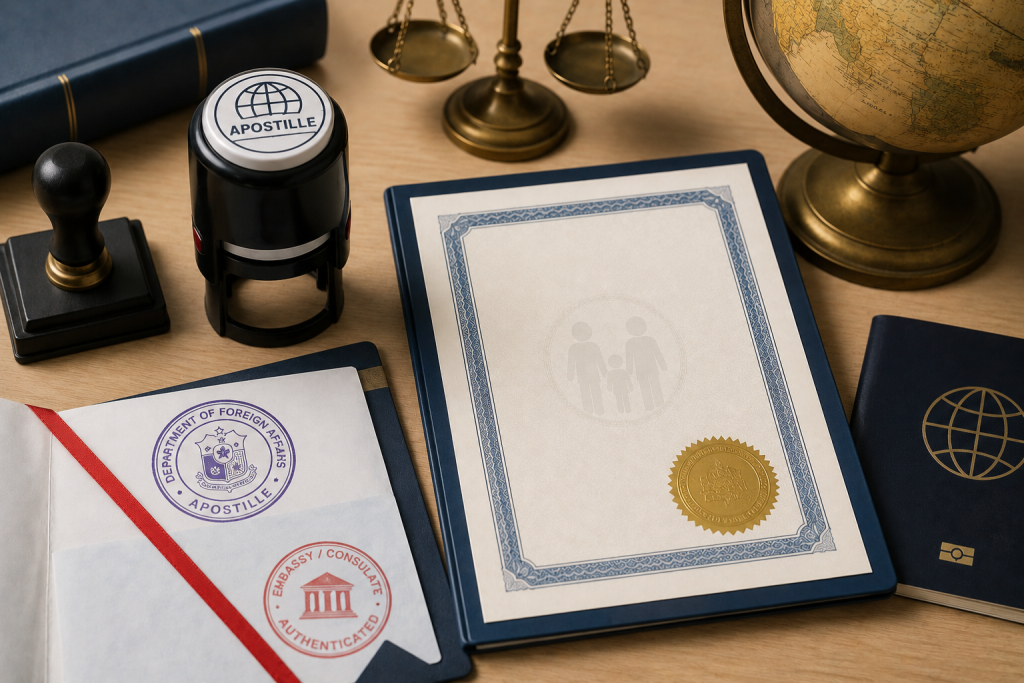
If the birth certificate you obtain will be used in another country for immigration, employment, legal proceedings, or civil registration abroad it may need to be authenticated before foreign authorities will accept it.
Apostille Certification
The Philippines is a signatory to the Hague Convention on Apostille, which means that documents intended for use in other member countries can be certified with a single Apostille stamp issued by the Department of Foreign Affairs, rather than requiring the multi-step authentication process previously known as “red ribbon.”
If your birth certificate needs to be used in a country that is also a Hague Convention member which includes the United States, most European countries, Australia, Japan, South Korea, and many others, an Apostille is the appropriate and sufficient form of authentication.
The Apostille is obtained from the Department of Foreign Affairs, and it is applied to the original civil registry document. A representative in the Philippines can handle this step on your behalf after obtaining the civil registry document.
Consular Authentication
For countries that are not Hague Convention members, a different authentication process applies typically requiring authentication by the Department of Foreign Affairs followed by legalization by the target country’s Embassy or Consulate in the Philippines. This process is more involved and takes longer than Apostille certification.
If you are unsure which process applies to your destination country, consult the relevant Embassy or Consulate of that country in the Philippines for current requirements.
Sequencing Your Request When Time Is Limited
Overseas Filipinos often need their birth certificate as part of a document package with a fixed submission deadline an immigration appointment, an employment processing cutoff, or a court proceeding date. When time is limited, sequencing matters.
Recommended sequence:
- Determine whether your birth certificate needs Apostille or consular authentication for use in your destination country this adds time to the process
- Choose your request method based on timeline: online request to a Philippine address is typically fastest for obtaining the document itself; Embassy request is slowest
- Request the document through your chosen method as early as possible
- If authentication is needed, arrange for your Philippine contact to bring the received document to the Department of Foreign Affairs for Apostille processing allow three to five additional business days for standard processing
- Once authentication is complete, arrange for international courier delivery to your address abroad
- Allow for international shipping time on top of all the above
For OFWs with a specific deployment date, beginning this process at least six to eight weeks before the deadline is a conservative but reliable approach.
Frequently Asked Questions for Overseas Filipinos
Can I order a birth certificate online if I am outside the Philippines and have it delivered to my address abroad?
Most official online ordering systems deliver within the Philippines only. For international delivery, the standard approach is to have it delivered to a Philippine address first, then arrange international courier forwarding separately through your Philippine contact.
Does my authorization letter need to be notarized at a Philippine Embassy?
For a standard civil registry outlet request, a notarized authorization letter is not strictly required; a signed letter is generally sufficient. However, having it notarized at your nearest Philippine Embassy or Consulate significantly reduces the chance of the request being questioned and is strongly recommended when managing the process remotely.
My birth certificate is needed for an immigration application abroad. Does it need an Apostille?
This depends on the country where you are submitting the application and whether that country is a member of the Hague Convention. Check with the specific immigration authority or Embassy you are applying through they will specify whether an Apostille is required or whether a plain, unauthenticated original is sufficient.
Can I get a birth certificate for my child who was born in the Philippines if I am now abroad?
Yes. If your child was born in the Philippines and their birth was registered at a Philippine local civil registry, you can request their birth certificate through any of the methods described in this guide. If your child was born abroad and their birth was reported to a Philippine Embassy or Consulate, their birth certificate is obtained through a different channel; contact the civil registry authority’s central office or the relevant Embassy for guidance.
What if I urgently need the document and cannot wait for standard processing?
Explore whether the Philippine Embassy or Consulate in your location can expedite a document facilitation request; some posts have provisions for urgent cases. Alternatively, instructing a representative in the Philippines to make a walk-in appointment at a civil registration outlet is the fastest way to obtain the physical document within the Philippines, since walk-in processing releases the document the same day if the record is found.
Final Thoughts
Being abroad does not mean being disconnected from Philippine civil registry services. The online ordering system, authorized representative arrangements, and Embassy-based requests collectively provide Overseas Filipinos with genuine, practical options for obtaining their birth certificate without returning to the Philippines. The most important factor in a successful remote request is preparation verifying the correct personal details before submitting, choosing the request method appropriate to your timeline, and building in enough lead time to account for processing, domestic delivery, potential authentication, and international shipping. A process that begins six weeks before a deadline is manageable. The same process begun six days before a deadline is a crisis. Start early, verify everything, and the document you need will find its way to you regardless of where in the world you are.